
Today Payrails is launching Payrails Merchant of Record (MoR), built to be outgrown.
Built by payments experts and running on Payrails orchestration, Payrails Merchant of Record lets companies use MoR in some markets and their own direct acquiring in others, from one platform, with full visibility into how payments perform. In each market a company assigns to MoR, Payrails becomes the legal seller. Payrails MoR calculates, collects and remits sales tax, VAT and GST, and handles invoicing, compliance, fraud prevention and disputes. If a company chooses to move a market to its own setup and bring these operations in-house, it can do so without re-integrating, keeping all the benefits of the Payrails platform.
Payrails MoR: At-a-glance
- What it is: Payrails Merchant of Record acts as the legal seller for your digital products in the markets you choose.
- Who it's for: AI, SaaS, mobile app and digital goods companies selling internationally, including subscription apps and AI products billed by usage.
- What's our unique approach:
- A hybrid model: run MoR and your own merchant IDs side by side on one platform, and switch between orchestration and MoR as your business needs change
- Saved cards live in Payrails Token Vault, independent of any single provider, and move with you when you “graduate” a market from the MoR
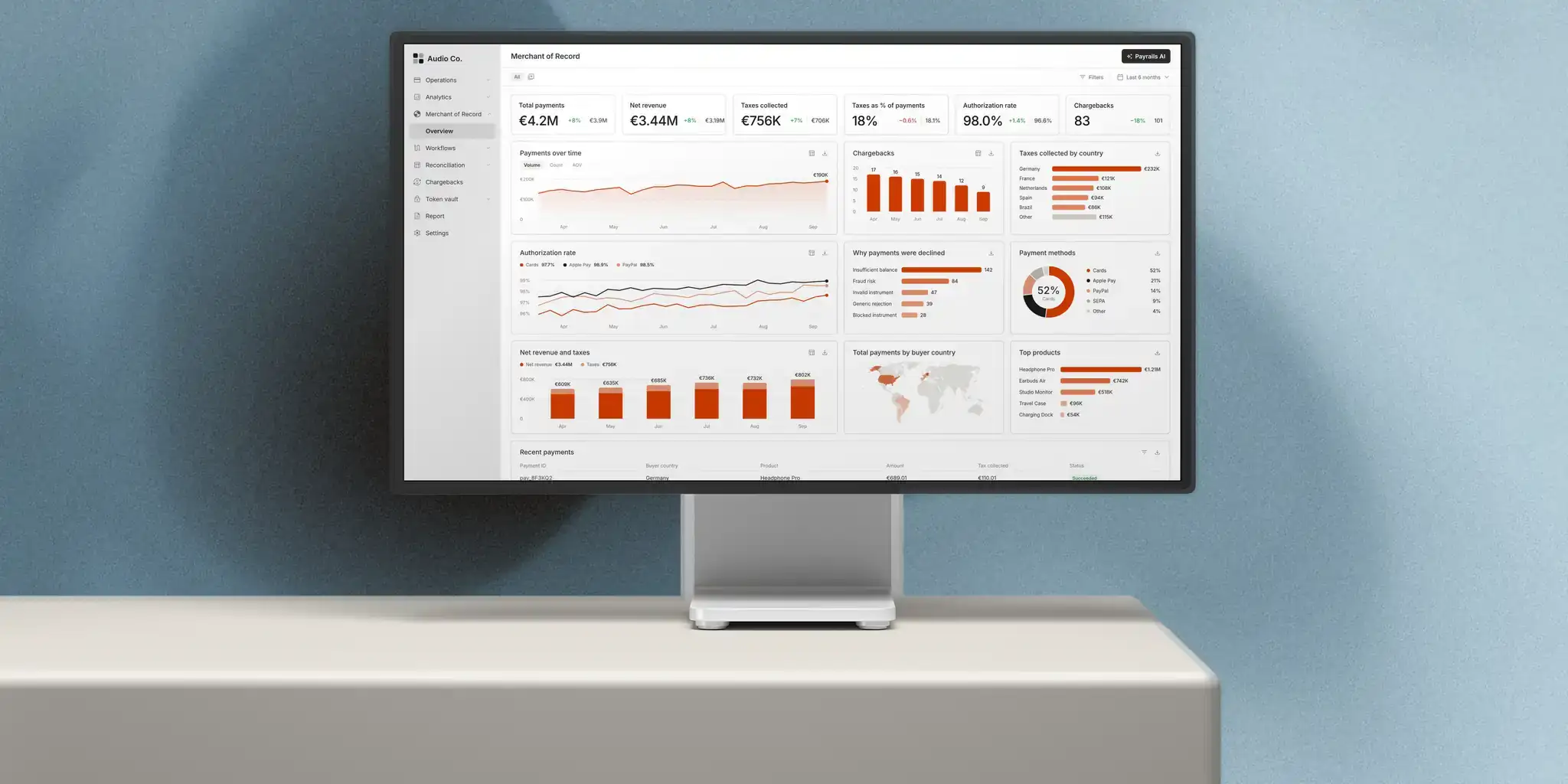
- Merchants get full visibility into authorization rates, fraud prevention, chargebacks and other performance data via the Payrails portal
- Availability: live from today.
Why we built Payrails MoR
AI has changed how fast software companies go global. According to Stripe, the 100 largest AI companies on its platform now earn 48% of their revenue outside their home market. A product can have paying customers in dozens of countries in its first days, and each of those customers expects to pay in their own way: PayPal in the US, Pix in Brazil, BLIK in Poland, UPI in India. Each sale also comes with a tax obligation: sales tax in California, VAT in Germany, GST in Australia.
A merchant of record solves that. It becomes the legal seller, so you can sell without needing an entity, tax registrations or a tax adviser in each market. The bigger challenge often comes later, once you have scaled. Many MoR products are not built for merchants seeking to optimize payments.
In a traditional MoR setup:
- Saved cards are held by the MoR provider
- Payments are often routed through a single acquirer
- Merchants gain limited visibility into why payments fail
By the time a few markets make up most of your revenue, you need to know how payments perform there: why they’re declined, where fraud comes from, which products attract disputes. In many MoR setups, that data is hard to see and harder to improve. Leaving can mean a new integration, a new checkout and asking every returning customer for their card again. The product that got you into a market becomes the thing keeping you from taking it to the next level.
Payrails MoR starts from the other end: we assume you'll outgrow it, one market at a time.
Developed by payments experts
Many merchant of record platforms began as software businesses solving a compliance problem with limited payment capabilities. At Payrails, we approach MoR with payments at the core. For years we've built and optimized payment infrastructure for merchants like Preply, DeepL, Eneba and other global leaders.
Payrails MoR is built on that foundation:
- Every MoR payment runs on Payrails orchestration. Routing, retries and payment method logic work the same way they do for our scaled enterprise merchants.
- Performance is the product. We treat authorization rates, fraud and chargebacks as numbers to improve with you, so we make them transparent to you.
- Saved payment credentials live in Payrails Token Vault. Independent of any single payment provider, so your customer base stays portable.
- Payment experts work alongside your teams. You get people who know how payments perform market by market, and they're there to ensure superior performance.
“Every merchant of record is a temporary answer to a permanent problem. Companies need one to get into new markets quickly, and then spend years trying to get back out. We're payments experts first, so we built Payrails MoR the way we'd want to use it: open, optimized for conversion, and with the option to move a market to your own setup without rebuilding anything. You keep all the benefits of staying on the same platform." – Orkhan Abdullayev, CEO / Co-Founder, Payrails
What makes Payrails MoR different
A hybrid model, built at our customers' request
The idea for Payrails MoR started with the companies already running payments on Payrails. As they expanded, they wanted the speed of a merchant of record without splitting payments across two setups or losing the visibility and control they already had.
Payrails MoR works market by market, alongside your own setup. Take an AI company already processing in the US and the UK on its own merchant IDs. It can use Payrails MoR to start selling across the rest of Europe and Asia, all under one account, one integration and one set of data.
When it’s ready to take on tax, invoicing and compliance in a market itself, it can move that market to its own merchant IDs, gradually or all at once. The integration stays the same, saved customers come with it, and new markets can be added to MoR at any time. This puts business back in control, which is something we believe in strongly at Payrails.
“Our customers asked us for this. They're growing faster than ever, and they wanted a merchant of record that keeps pace without taking away visibility or control. With a hybrid model, they can use their own merchant IDs where they have them and our MoR where they don't, and switch whenever the business needs to. It's a different way of doing merchant of record, and it gives digital businesses peace of mind as they grow." – Emre Talay, COO & Co-Founder, Payrails
Built for superior checkout conversion
With a merchant of record, every failed payment is still lost revenue for you. Payrails MoR runs every payment on Payrails orchestration, with multi-processor routing, local acquiring and automatic retries across 100+ integrations. That gives every MoR merchant the same payment performance our largest enterprise customers get. Buyers pay in their local currency with the payment methods they know, and returning customers pay with cards saved in Payrails Token Vault instead of re-entering them.
You see every number behind every payment
You can’t fix what you can’t see. Payrails MoR shows your authorization rates, fraud and chargebacks in the Payrails portal, down to individual decline reasons. A dedicated MoR analytics dashboard tracks performance across markets and products, so you can spot the market where approvals are slipping or the product that attracts disputes. Our payment experts work from the same view, so they can catch issues early and fix them for you.
What Payrails MoR includes
Seller of record in the markets you choose
Payrails resells your digital product to buyers under our entity. We handle:
- Processing of payments in local currencies and payment methods
- Calculating, collecting and remitting sales tax, VAT and GST to tax authorities, including filings
- Compliant receipts and co-branded invoices
- AI-powered fraud prevention and chargeback management
A checkout that lives in your product
Embed the Payrails MoR Drop-in in your app or website, or use a hosted payment page. Your brand appears on the checkout, co-branded invoices and card statement, so buyers recognize what they bought.
One platform, one integration
MoR uses the same API and SDK as Payrails orchestration, with multi-processor routing, automatic retries and 100+ integrations.
Modular by design
Companies that already have their own setup in a market can still use individual capabilities there, such as orchestration and custom integrations, on the same platform as the MoR.
Availability and getting started
Payrails MoR is available from today. Onboarding requires three steps:
- Standard business verification (KYB)
- Configuration and approval of your product catalogue - can be done via the Payrails portal
- Integration of the Payrails MoR drop-in or a hosted payment page
After thorough integration testing, assisted by the Payrails team, merchants are ready to go live with Payrails MoR.
Existing Payrails customers can add MoR in a new workspace alongside their current setup.
Merchant of record questions, answered
What is a merchant of record?
A merchant of record (MoR) is the legal entity that sells a product to the end customer. It appears as the seller on the receipt and the card statement. It is responsible for:
- collecting and remitting sales tax, VAT and GST
- issuing compliant invoices
- meeting local consumer and payments regulations
- handling fraud prevention and chargebacks
Companies use a merchant of record to sell in markets where they don't have their own legal entity, or where they'd rather not take on local tax and compliance themselves.
What's the difference between a merchant of record and a payment service provider (PSP)?
A PSP processes payments on your behalf, but you remain the legal seller, so the tax registrations, invoicing and compliance in each market are yours. A merchant of record becomes the legal seller: it resells your product to the buyer and takes those obligations on. Many companies use both: a PSP where they have an entity, and an MoR where they don't.
What's the difference between a merchant of record and a payment facilitator?
A payment facilitator lets businesses accept payments under its master merchant account, but each business is still the seller and still owns its tax and compliance obligations. A merchant of record is the seller, so those obligations sit with the MoR.
When does a company need a merchant of record?
Usually when it sells digital products to buyers in countries where it has no entity and no tax registration. Many jurisdictions tax digital sales where the buyer is located:
- The EU charges VAT on digital services based on the buyer's country.
- US states apply sales tax once a seller passes economic nexus thresholds, often $100,000 in annual sales.
A merchant of record meets those obligations so you don't have to register in each place.
Why do AI and SaaS companies use merchants of record?
AI and SaaS products are global from launch, while legal entities and tax teams take months to set up. An MoR closes that gap. It's especially common for:
- AI products billed by usage or subscription
- Mobile and subscription apps selling outside the app stores
- Digital goods such as games and online courses
How much does a merchant of record cost?
MoRs typically charge a percentage of each transaction plus a fixed fee, often around 5% plus a fixed per-transaction fee. It's higher than standard payment processing because the fee also covers tax compliance, regulatory work and transaction risk. For a new market, it's often cheaper than building that capability in-house. The gap narrows as the market's volume grows.
What are the downsides of using a merchant of record?
The main things to weigh are:
- Cost at scale
- Less control over checkout and payment performance
- Lock-in: depending on the provider, saved cards and customer history may stay with the MoR, payments may run through a single acquiring setup, and performance data may be limited
- Reserves: some MoR players might have extensive holding period for your payouts
Before signing, ask how you'd leave.
When should you move from a merchant of record to your own entity?
Consider moving a market to your own entity when:
- the MoR fee on that market's volume costs more than running tax and compliance yourself
- you want direct acquiring relationships and negotiated rates there
- you have expertise to manage payment operations effectively and efficiently
- buyers in that market need to contract with you directly
What happens to saved cards and subscriptions when you leave a merchant of record?
That depends on where the stored payment credentials live. If they stay with the provider, leaving means asking returning customers and subscribers to enter their card details again, and some won't. With Payrails MoR, saved credentials live in Payrails Token Vault, independent of any single payment provider, so they move with you when you graduate.
Can you use a merchant of record in some countries and your own entity in others?
With Payrails, yes. You can run Payrails MoR in the markets you choose, and your own merchant IDs and payment providers everywhere else. It's all under one account with the same API and SDK.
What should you ask before choosing a merchant of record?
- Can I see authorization rates, decline reasons, fraud and chargeback data?
- How many acquirers do you route through, and can a failed payment be retried elsewhere?
- What happens to my saved cards if I leave?
- Can I use the MoR in some markets and my own entity in others?
- Are there reserves or payout holds, and on what terms?
- Does my brand appear on the checkout, invoices and card statement?
- What are the costs?
- What does it cost to move a market to my own entity?
Ready to sell in your next market?
Payrails MoR gets you selling into new markets in minutes. We handle the tax, invoicing and compliance, and you can move any market to your own setup whenever you're ready. Book a walkthrough and we'll show you MoR in action.

I am the text that will be copied.