Reducing PCI scope matters, but not if it leaves you dependent on a payment provider that's hard to leave. A payment token vault keeps card credentials out of your payment flow. According to Visa, about 40% of merchants keep the token-to-card mapping with their PSP: simple, with some lock-in. With an independent vault, you stay free to switch providers.
Payment token vaults differ from similarly named tools such as Auth0's Token Vault and HashiCorp Vault.
The decision is between three models: PSP-owned, independent, or in-house. Each affects your PCI scope and ability to move credentials between providers.
Key points
- The vault holds card PANs and their tokens, so your own systems never store a card number.
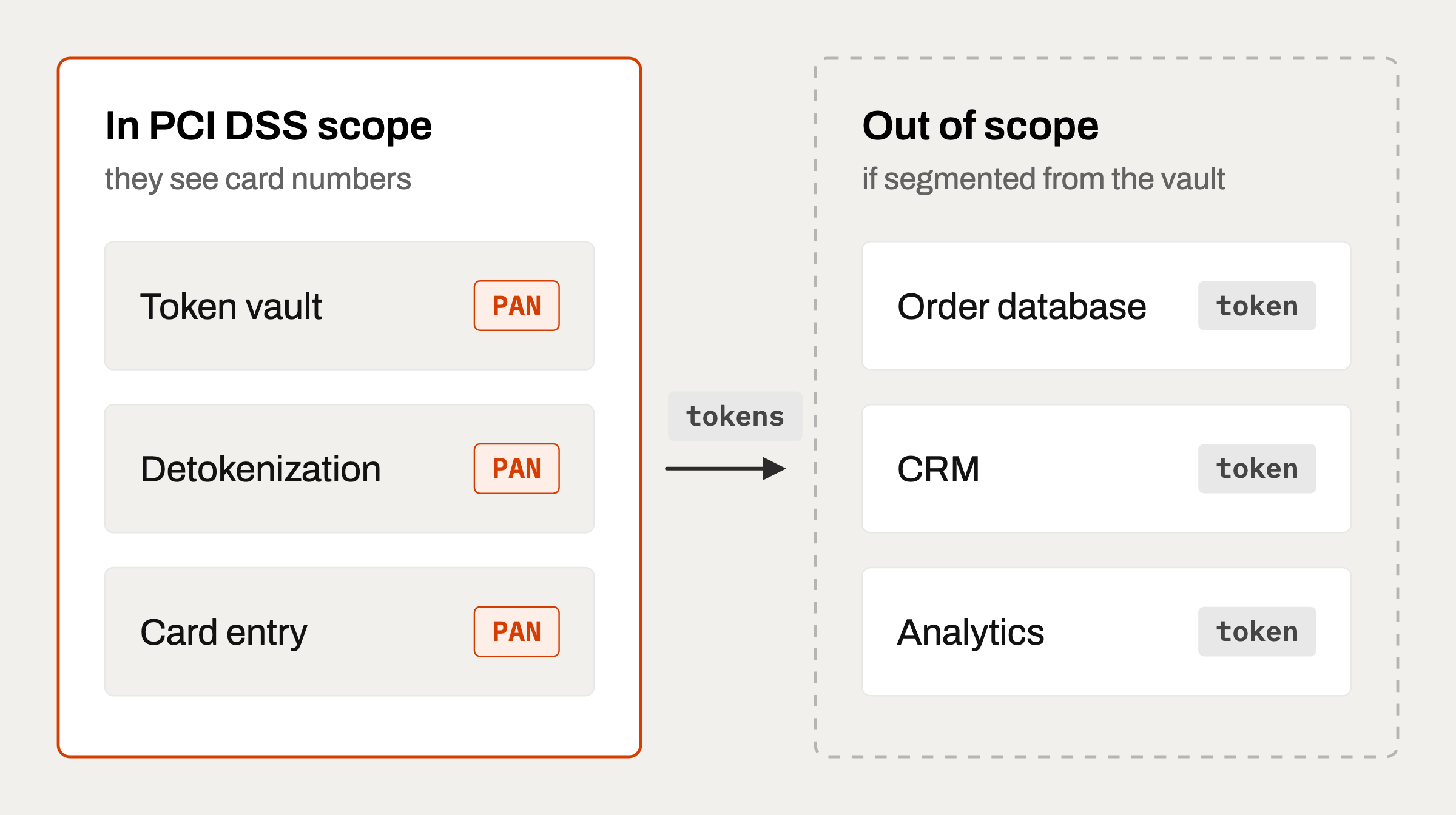
- The vault is always in PCI DSS scope. Token-only systems can leave scope once they're segmented from it.
- A PSP-owned vault is the simplest setup, but its tokens work only with that PSP.
- An independent vault keeps the mapping outside any PSP, so you can route payments and switch providers without collecting cards again.
- Before moving stored cards, confirm your export rights and how recurring payments will continue.
What is a payment token vault?
A payment token vault is a PCI-scoped system that stores card PANs and what stands in for them, such as wallet credentials and network tokens, then issues a token you can use in place of the card. That token moves through your systems. The underlying card data stays out of the flow. PCI SSC guidance calls it the card data vault, "the central repository for PANs and tokens" (Tokenization Guidelines, section 2.1.3).
The application token a merchant works with is different from the stored credential behind it. The token you see in your own systems is only a reference to the card.
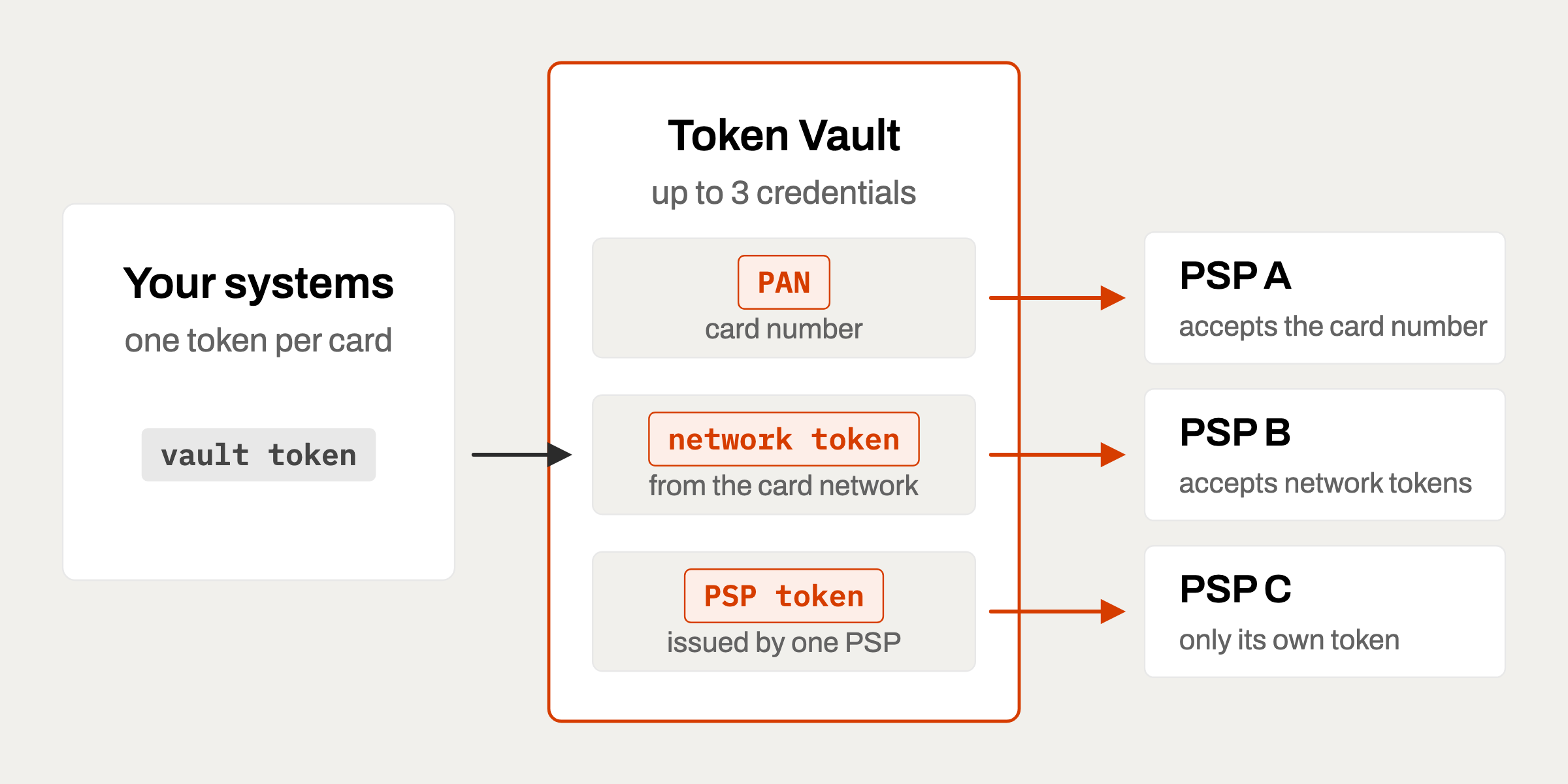
The credential it points to, whether that's the actual PAN or a network token, remains inside the vault and out of reach of anything that doesn't specifically need it to process a transaction. One stored card can hold three kinds at once: the card details and a network token, plus the tokens each PSP issued for it.
An orchestration platform keeps the payment credential independent of any individual PSP, so you can use a consistent token at the orchestration layer while the underlying credential works with whichever processor you select for the transaction. That allows a fallback: the PSP token first, then a network token, then the PAN at a different provider. Payrails groups all three under one instrument.
Which credentials does a payment vault store?
Cards, PSP tokens, wallet credentials (such as Apple Pay and Google Pay), and network tokens are distinct payment instruments at authorization. Each has its own rules for how it's stored and used.
Storing a credential is a separate function from provisioning or updating it during a transaction. A vault might store a network token, for example, without necessarily managing the lifecycle updates that keep it current when a card is reissued. Check each capability for the model you're considering. "We store it" doesn't automatically mean "we keep it up to date."
For a fuller breakdown of how these token types differ, see network vs gateway vs vault tokens.
How do the 3 types of token vault compare?
There are three main ways to manage the token-to-card mapping: through a PSP-owned vault, an independent vault (also called PSP-agnostic), or an in-house setup.
A PSP-owned vault stores the PAN and returns that provider's own reference token. It's simple within one provider's ecosystem, but harder once you add or switch PSPs. Because the credential relationship belongs to that provider, migration can mean moving stored cards or establishing those payment credentials again elsewhere. Failing a subscription over to another provider means handing it the card details, on the export terms the first PSP sets.
An independent vault keeps that mapping outside any individual PSP. This gives you PSP-agnostic storage, so the same underlying payment credentials can support a multi-PSP setup without making one processor the system of record. That's especially useful alongside payment orchestration, where routing flexibility depends on sending transactions to different providers. The PCI guidelines call this an outsourced vault: the token service provider is responsible for its PCI controls (section 2.4.1).
An in-house vault gives you maximum control over the setup and the freedom to design it around your own payment architecture. The drawback is that you carry its PCI DSS compliance and its day-to-day operation yourself: vaulting becomes infrastructure you run. Under the PCI guidelines, every part of it, from the token mapping to key management, has to run inside a PCI DSS environment (section 2.2).
| Model | Mapping control | Processor use | Merchant work | Main limit |
|---|---|---|---|---|
| PSP-owned | Held by the PSP | Tied to that PSP | Minimal | Migration difficulty |
| Independent | Held by a neutral vault provider | Works across multiple PSPs | Moderate (one integration) | Vendor selection and contract terms |
| In-house | Held entirely by the merchant | Fully flexible | Full security and compliance burden | Ongoing operational cost |
How does a token vault map card data?
A token vault maps each stored card to a token, then detokenizes the underlying credential only for an authorized provider. This keeps the raw PAN from being exposed any more broadly than a specific transaction requires.
The data path follows a defined sequence: collection, storage, tokenization, detokenization, then delivery. The PAN can stay outside the merchant's own systems throughout that process.
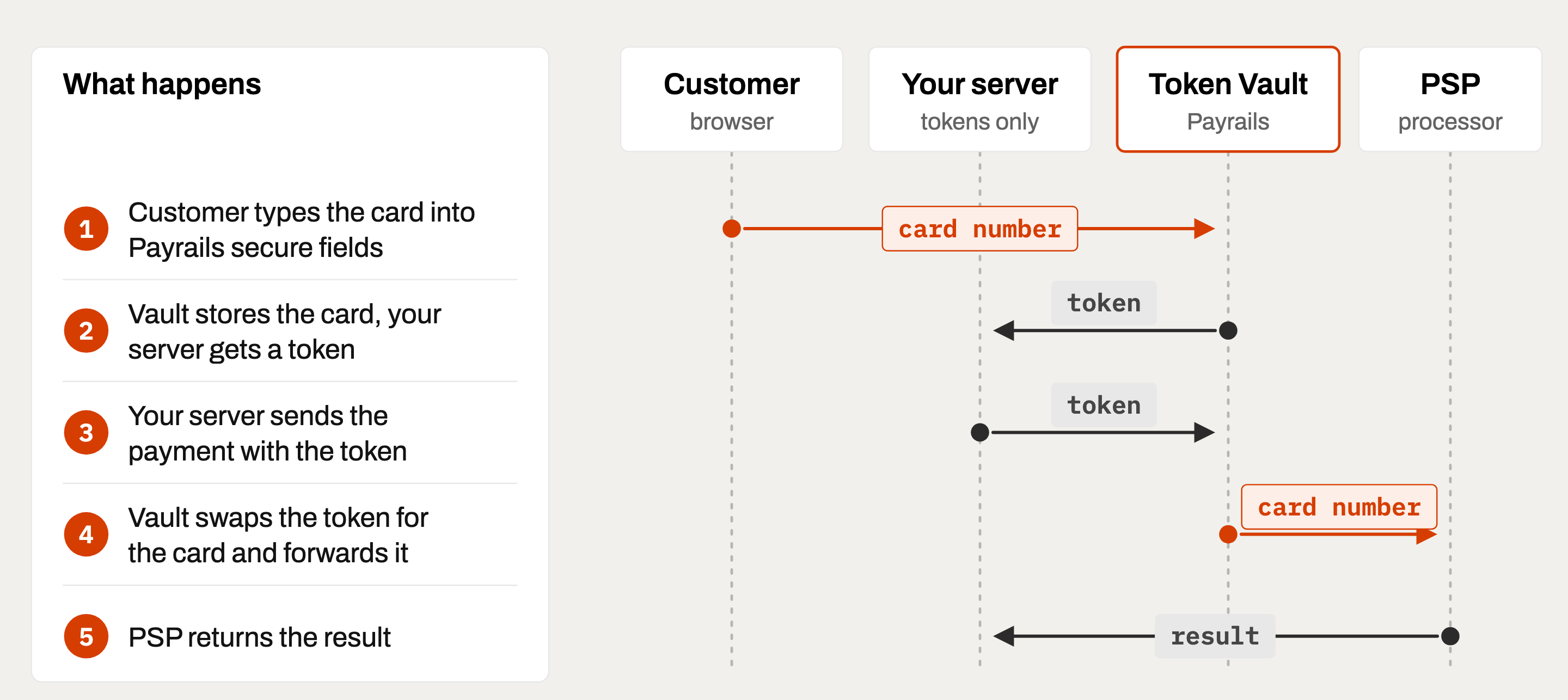
Detokenization is when the original card credential is retrieved using its token reference and made available where authorized and needed.
Alias stability matters for the same reason. If you're using a PSP-agnostic vault to preserve routing and provider flexibility, the merchant-facing reference needs to remain stable when the processor changes. If the token no longer works after you switch PSPs, you're back to the dependency you're trying to avoid. A token issued by one PSP, for example, can't be used to charge a card through another. Moving the card means forwarding the underlying details.
Who should control the token-to-card mapping?
It depends on what you expect to change. If you plan to stay with one PSP and want the least work, letting your PSP hold the tokens is a fair trade. If you route across PSPs or want a clean exit at contract renewal, control of the mapping matters more than setup effort. In our experience, the usual trigger is a second PSP.
The cost of the PSP-owned option arrives later, when you want to route elsewhere or migrate. Merchant-owned payment vaults vs PSP tokenization goes deeper on that trade-off.
Two questions settle it for most teams: which exits do you want to keep open, and how much of running a vault can your team carry?
Does a token vault reduce your PCI scope?
Yes, for the systems that only see tokens. The vault stays in scope, and so does anything of yours that still touches card data.
The PCI Security Standards Council's tokenization guidelines (2011) treat every component of a tokenization system as part of the cardholder data environment, always in scope. Systems that store or process only tokens can be out of scope if the PAN can't be recovered from the tokens and those systems are segmented from the vault. Your QSA makes that call.
One exception catches merchants out. Tokens that can start a payment on their own, which the guidelines call high-value tokens, may stay in scope even though they can't reveal a PAN. The guidelines tell merchants to check with their acquirer or the card schemes. The reason: such tokens could be "monetized" or used for fraud (section 4.1).
What stays with you (section 2.4.1):
- How card data is collected and transmitted.
- Who can trigger detokenization.
- Network segmentation between your systems and the vault.
PCI DSS 4.0: what's new covers the wider requirements that still apply.
Can you move stored cards to another payment provider?
Yes, if you have the right to export the card data and the destination can import it. A stable token helps, but on its own it doesn't make cards portable. Each PSP sets its own terms. Stripe will transfer stored cards only to a PCI DSS Level 1 processor and leaves subscriptions and payment history behind. Braintree allows at most two exports.
Plan for time, and check the export for expired cards first: a new PSP can run account updater on stale cards straight after import and bill you for it.
Confirm these before you plan a move:
- Do you have contractual rights to export the stored card data?
- Will your tokens and aliases still work after the move?
- How will subscriptions continue? For merchant-initiated payments, the new PSP needs the network transaction reference from the original payment, so customers aren't asked for their CVV or 3DS again.
- Who controls any network tokens involved?
- Does your vault support the destination PSP?
Where Payrails fits
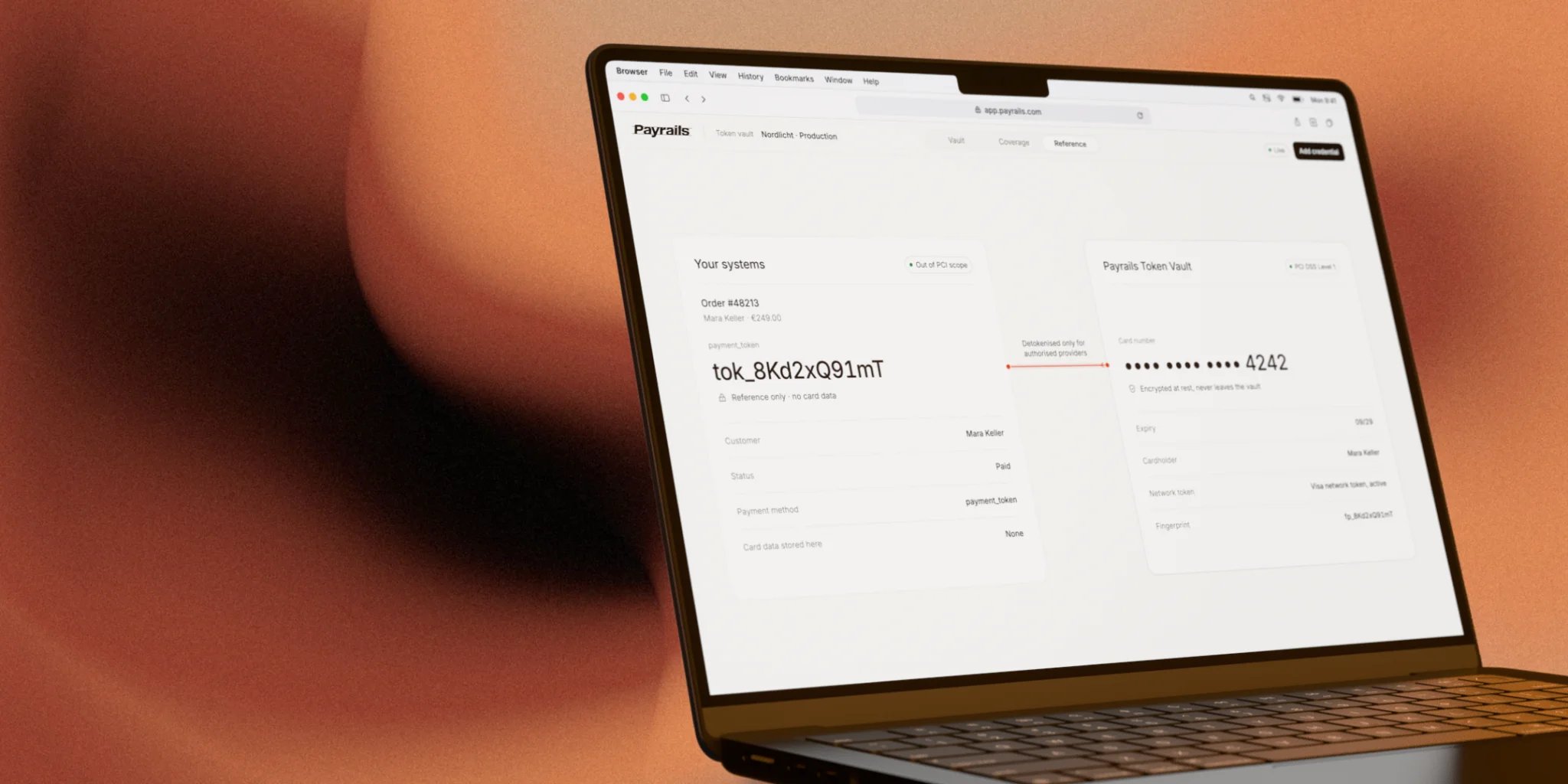
Payrails Token Vault keeps credential storage separate from processing. Cards are collected through the Token Vault SDKs, so the PAN stays off your servers, and the vault forwards card data to whichever PSP you pick for each payment.
Because the original card data stays in the vault, you can switch PSPs without customers re-entering their cards, including for subscriptions. Each stored card can also carry a network token, and Visa reports that tokenized transactions were approved 4.8% more often in 2025.
To bring cards in from your current provider, Payrails coordinates the export with that provider. Once the file arrives, Payrails checks it and imports the cards. Vinted moved its existing tokens from all its integrated PSPs into Payrails Token Vault this way, without friction for its members, and now holds its tokens independently of any processor.
"We chose to work with Payrails because of their deep understanding of marketplace payments, their experience with tokenization technology and their focus on offering a token vault with agnostic payment tokens that can be used across all of our processors. It's a streamlined solution that solves our main pain point with our tokenization setup while being easy to manage and delivering excellent results."
– Vinted, customer story
Before you choose a model, ask of each one: who can detokenize your cards, and which PSPs can they reach? Book a demo and we'll walk through portability and PCI scope for your setup.
FAQs
Is a token vault the same as tokenization?
No. Tokenization is the process of replacing a card number with a token. A token vault is the system that does it and stores the mapping between each token and its card. You can use tokens without running a vault, for example PSP tokens, but then the PSP holds the mapping.
Does a token vault make me PCI compliant?
No. It reduces how many of your systems are in PCI DSS scope, because systems that only see tokens can be out of scope if they're segmented. You stay responsible for how card data is collected, who can detokenize it, and network segmentation. Your QSA decides the final scope.
Can I use network tokens with a token vault?
Yes. A vault can store a network token next to the card it came from and send each PSP the credential it accepts. Check whether the vault also handles the network token's lifecycle updates, which are a separate capability from storage.

I am the text that will be copied.