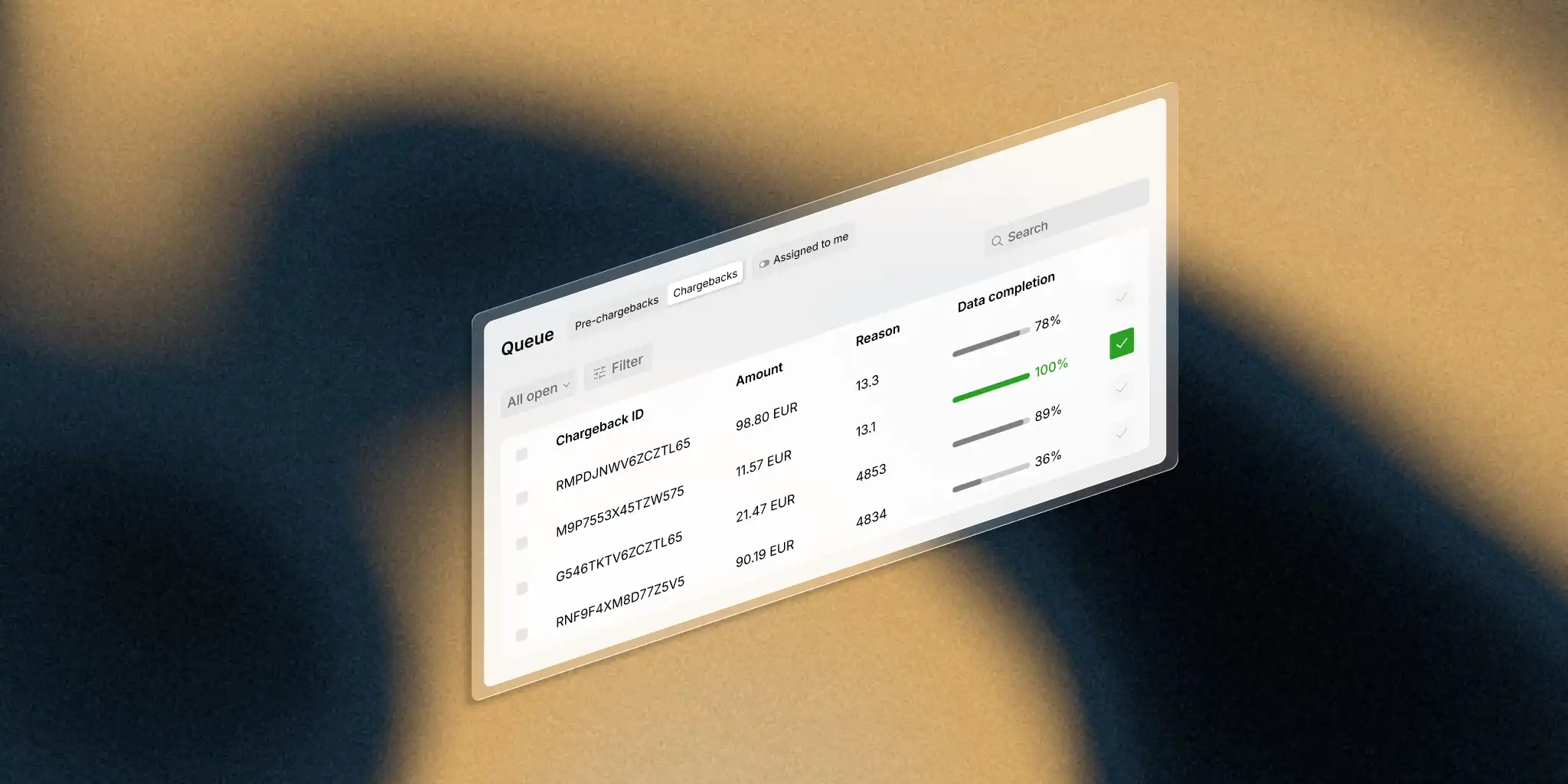
At Payrails, we strive to build a platform that goes beyond standalone orchestration. Rather than replacing a merchant's payment infrastructure, our platform is really built with the intent to enhance and complement what they already use. Many of us come from enterprises (I joined from DeliveryHero) and understand how unrealistic changing everything at once is when you’re processing 10 million transactions per day.
I joined Payrails this summer to expand our product beyond typical orchestration and vault offerings. During onboarding, I evaluated opportunities that could add immediate value to our merchants. I noticed that many existing merchants and prospects were asking about chargebacks — so I dug deeper.
A few merchant meetings later, it was getting clear that this is an open wound. Here’s what I heard:
- One merchant had a team of 6 people in Bulgaria handling chargebacks using a huge excel sheet and not even being able to handle all cases.
- One started building a product in-house but ran out of tech resources mid-way, so now they’re stuck with a complicated process.
- One built the product internally, but was not able to handle the email chargebacks.
- Several others were using an external provider but planned to start building internally because of the high cost. Turns out providers were taking a percentage of the winnings, which doesn’t make much sense if you’re already disputing and winning chargebacks on your own…
It was madness!
So as an orchestrator, we naturally wanted to partner to solve this issue. That’s what an orchestrator does!
I went ahead and talked to all of the famous chargeback disputing companies and also to their merchants — it was fascinating. But at the end of the day nobody was a good fit for what we needed to solve for.
A build-vs-buy document later, together with the commitment of our first design partner, we decided to build in-house. We have intrinsic capabilities that stand-alone providers can’t replicate and we believe this will bring value to the entire payments ecosystem because:
- We have more data. For our existing customers, we can provide unique insights and recommendations right out of the gate on who should handle chargebacks, and how. All of this data is already available in our orchestrator, fraud integrations or analytics/reconciliation modules. Every chargeback is different and merchants need a solution that can cater for this reality. Nobody else can replicate this.
- We automate complex processes. Workflows are at the core of Payrails, so if a merchant needs to cluster customers, cancel subscriptions, refund, write customer service emails or issue sorry vouchers — we can do it all automatically through our integrations. That’s very hard to do if you’ve not built with workflows in mind.
- We believe share-of-win pricing is fundamentally flawed. It requires merchants to pay for chargebacks they would likely have won independently, even though providers take no liability and assume no financial risk. Payrails instead charges a flat transaction fee, accurately reflecting the value of improving chargeback workflows and insights — without monetizing outcomes that are not incremental.
- We know enterprises. We understand the high cost of acquisition in competitive businesses and the value of loyal customers. Our merchants need a product that helps turn customers with problems into loyal customers — not just blindly winning chargebacks “with AI”. We turn chargebacks into opportunities!
Now, having put together a team at Payrails, we are working hard on our go-live with our design partner Flix in January 2026.

As a merchant in Q1, you’ll get a single platform to manage all disputes across acquirers and payment methods (Payrails is an integration machine!). If you’re already a Payrails orchestration merchant, you can already use existing transaction data — otherwise you can easily automate order data uploads. In the MVP phase, you’ll be able to trial Payrails LLM-generated dispute files.
Throughout 2026 we’ll work on introducing automated flows, improving representment quality and expanding ecosystem integration capabilities. I am confident we can solve these real problems for our merchants and their customers.
All-in-all, I’m excited about 2026 — where our chargeback product should become a very compelling alternative in the market.
We believe that merchants who care about their customers shouldn't build this capability internally. There's a risk it will be deprioritized, and internal teams lack the incentive for long-term investment once the problem is sufficiently covered, meaning it will never reach its full potential.
The internal build requires significant upfront investment to create a functional tool. Once it reaches a "good enough" state, priorities naturally shift to higher-ROI initiatives. The tool stops evolving, becomes harder to maintain, and loses efficiency as chargeback rules change or when the business adds new PSPs and payment methods.
With Payrails, the trajectory is reversed. You start with minimal setup — mostly configurations and connecting your order data — then the product continuously improves. New integrations, smarter automation, and higher win rates are all part of the roadmap. Costs remain predictable (and reasonable) while value compounds over time.
Want to see how Payrails can help your business win more disputes and transform your approach to chargebacks? Contact our team for a demo.

I am the text that will be copied.